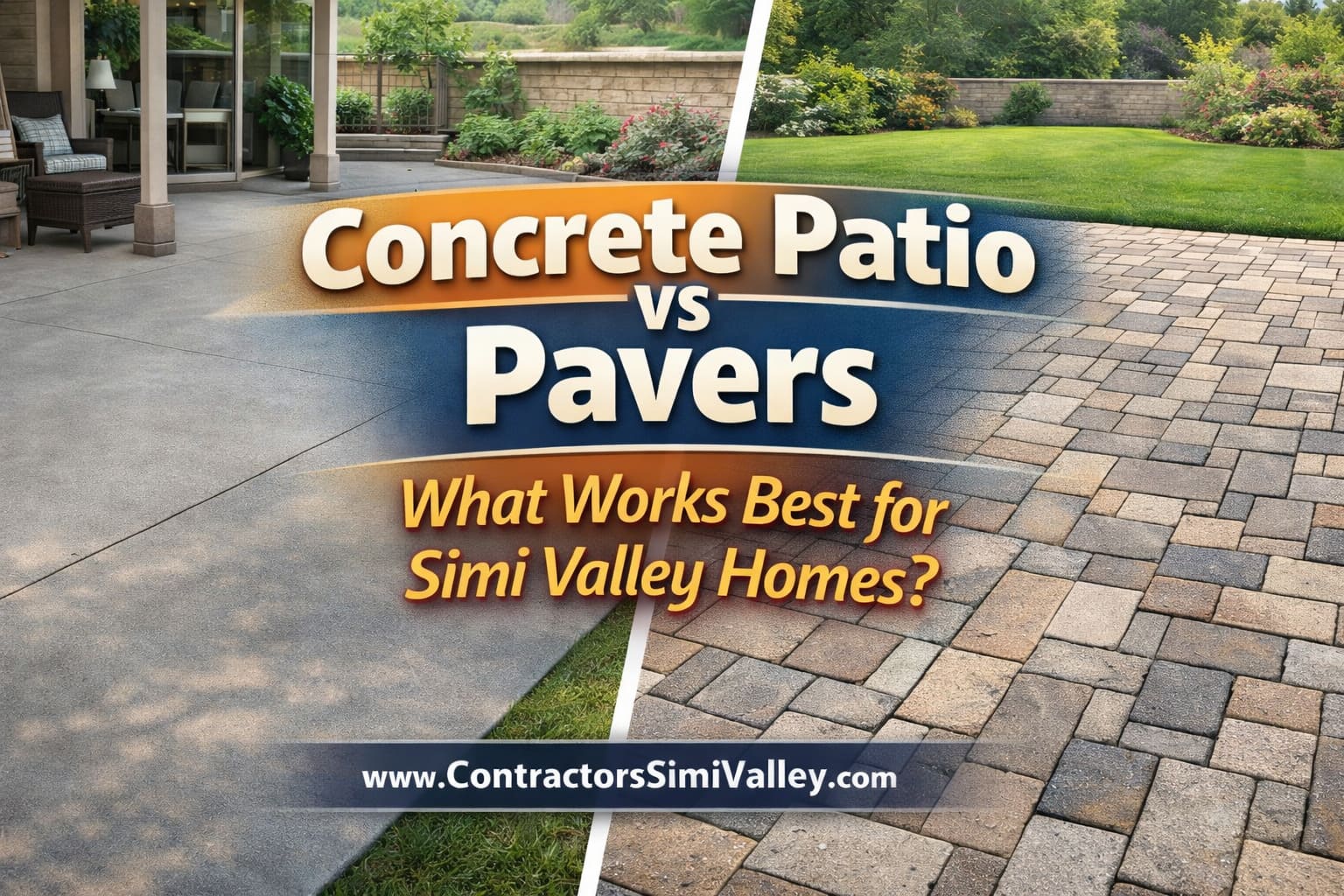
Quick Comparison Summary
Based on our contractors' experience with hundreds of Simi Valley patio installations, here's the 2026 overview:
- Concrete Patios: $8-$25/sq ft installed, best for: flat budgets, contemporary designs, pool decks
- Paver Patios: $15-$35/sq ft installed, best for: hillside properties, traditional styles, easier repairs
- Simi Valley Climate Impact: Both need proper installation to handle 90°F+ summers and occasional freezes
- Key Decision Factors: Budget, property slope, HOA requirements, desired maintenance level
- ROI Range: 60-85% for quality installations, higher for integrated outdoor living spaces
These insights come from actual patio projects across Wood Ranch, Big Sky, east Simi Valley, and hillside areas.
Choosing between a concrete patio and pavers is one of the most common decisions Simi Valley homeowners face when creating outdoor living spaces. Over the past ten years, we've seen both materials succeed and fail in our unique local conditions. What works beautifully in coastal Ventura might crack in Simi Valley's temperature extremes. What looks perfect in Wood Ranch might seem out of place in east Simi Valley.
This guide isn't about declaring one material "better" than the other. It's about understanding which option works best for your specific Simi Valley home, budget, and lifestyle. Our contractors have installed both materials in every neighborhood, from elaborate paver patterns in Wood Ranch backyards to simple, durable concrete pads in east Simi Valley. The right choice depends on your particular situation.
Local Insight: Simi Valley's Patio Challenges
Simi Valley presents three unique patio challenges: 1) Temperature swings from 90°F+ summers to occasional winter freezes, 2) Hillside properties with drainage and soil stability issues, and 3) HOA design restrictions in communities like Wood Ranch. Understanding these local factors is crucial for patio success.
Cost Comparison: Concrete vs Pavers in Simi Valley 2026
Let's start with what most homeowners care about first: the budget. Here's how costs break down for Simi Valley patio installations:
| Material Type |
Cost per Square Foot |
400 sq ft Patio Cost |
Key Cost Factors in Simi Valley |
| Basic Concrete (Broom Finish) |
$8 - $12 |
$3,200 - $4,800 |
Simple installation, minimal finish work, best for utility areas |
| Stamped/Colored Concrete |
$12 - $25 |
$4,800 - $10,000 |
Pattern complexity, color options, sealing requirements, popular in Wood Ranch |
| Basic Concrete Pavers |
$15 - $20 |
$6,000 - $8,000 |
Paver quality, pattern complexity, base preparation, most common choice |
| Natural Stone Pavers |
$20 - $35+ |
$8,000 - $14,000+ |
Stone type (flagstone, travertine, bluestone), cutting requirements, premium option |
| Permeable Pavers |
$18 - $28 |
$7,200 - $11,200 |
Specialized for drainage, may qualify for Simi Valley water conservation credits |
Complete 400 sq ft Patio Cost Breakdown Example
Stamped Concrete Patio in Wood Ranch:
- Excavation & Grading: $800-$1,500
- Base Material (4-6" compacted): $1,200-$1,800
- Concrete Materials (4" slab): $1,600-$2,000
- Stamping/Coloring Labor: $1,200-$2,000
- Sealing: $400-$600
- Edge Forms & Finishing: $600-$900
- Contractor Overhead/Profit: $1,800-$2,700
- Total: $7,600-$11,500
Concrete Paver Patio in Big Sky:
- Excavation & Grading: $800-$1,500
- Base Material (6-8" compacted): $1,800-$2,400
- Paver Materials: $2,400-$3,200
- Sand & Edge Restraints: $400-$600
- Installation Labor: $2,000-$2,800
- Sealing (optional): $400-$600
- Contractor Overhead/Profit: $2,100-$2,900
- Total: $9,900-$13,000
Cost Insight: While pavers typically cost 30-50% more upfront than basic concrete, they often have lower long-term repair costs in Simi Valley's climate. The "sweet spot" for most Simi Valley homeowners is stamped concrete ($12-18/sq ft) or mid-range concrete pavers ($16-22/sq ft).
Durability in Simi Valley's Climate: How Each Material Performs
Simi Valley's climate is tougher on outdoor surfaces than many realize. Here's how each material holds up:
Concrete Patio Performance
- Heat Resistance: Dark concrete can reach 130°F+ in summer sun, lighter colors better
- Freeze-Thaw: Prone to cracking if not properly air-entrained for freeze cycles
- Seismic Activity: Large slabs can crack during earthquakes, control joints help
- UV Exposure: Sun fades colored concrete, requires UV-resistant sealing
- Chemical Resistance: Pool chemicals can damage surface if not properly sealed
- Typical Lifespan: 15-25 years with proper installation and maintenance
Paver Patio Performance
- Heat Resistance: Individual pavers expand less than large concrete slabs
- Freeze-Thaw: Handles better due to flexibility and drainage between pavers
- Seismic Activity: More flexible, individual pavers can be easily replaced if damaged
- UV Exposure: Natural stone colors fade less than concrete dyes
- Chemical Resistance: Generally good, but some stones can be etched by acids
- Typical Lifespan: 25-40+ years, with individual paver replacement as needed
Simi Valley-Specific Durability Notes
Our contractors have observed: 1) East Simi Valley's clay soil causes more movement issues than west side sandy soil, 2) Hillside properties with water runoff need superior drainage under pavers, 3) North-facing patios in shadow stay cooler and have fewer expansion issues, 4) Areas under trees get leaf stains that are harder to remove from textured concrete than smooth pavers.
Maintenance Requirements: Annual Upkeep in Simi Valley
Maintenance is where these materials differ significantly. Here's what you can expect:
| Maintenance Task |
Concrete Patio |
Paver Patio |
Simi Valley Frequency |
| Cleaning |
Pressure wash annually, mild detergent for stains |
Pressure wash as needed, careful with joint sand |
Spring (after pollen season) and fall |
| Sealing |
Every 2-3 years ($0.50-$1.00/sq ft) |
Every 3-5 years ($0.75-$1.25/sq ft) optional but recommended |
Fall (before rainy season) |
| Joint Maintenance |
Control joint caulking every 5-7 years |
Sand replenishment every 2-3 years |
As needed, check after heavy rains |
| Weed Control |
Occasional in cracks, use concrete-safe herbicides |
More common in joints, polymeric sand reduces weeds |
Spring and summer growing season |
| Stain Removal |
Can be difficult, especially oil or rust stains |
Easier on pavers, replace individual stones if needed |
As needed, address quickly |
| Major Repairs |
Resurfacing after 10-15 years ($3-$7/sq ft) |
Individual paver replacement ($20-$50 each + labor) |
As damage occurs |
Installation Process: What Happens in Your Simi Valley Backyard
The installation process differs dramatically between materials. Understanding this helps set realistic expectations:
Concrete Patio Installation Timeline (400 sq ft)
- Site Preparation (1-2 days): Excavation, grading, form building, base compaction
- Concrete Pour (1 day): Delivery, placement, initial finishing - weather critical
- Curing Period (3-7 days): No foot traffic, keeping moist for proper strength development
- Stamping/Finishing (if applicable, 1 day): After concrete sets but before fully hard
- Sealing (after 28 days): After full cure, apply sealant
- Total Time to Usable: 7-10 days minimum, 28 days for full strength
Paver Patio Installation Timeline (400 sq ft)
- Site Preparation (1-2 days): Excavation, grading, more extensive base preparation
- Base Installation (1-2 days): 6-8" compacted base material, precise grading
- Sand Bed & Edge Restraints (1 day): Leveling sand, install perimeter restraints
- Paver Installation (1-3 days): Laying pattern, cutting as needed
- Joint Sand & Compaction (1 day): Spread sand, compact into joints
- Sealing (optional, 1 day): After cleaning, apply sealant
- Total Time to Usable: Immediately after completion
Simi Valley Installation Considerations
Our contractors schedule differently based on season: Concrete pours scheduled for spring/fall to avoid extreme heat (causes rapid curing) or rain. Paver installations can often proceed year-round. Hillside properties require more extensive site preparation for both materials. In Wood Ranch, HOA inspections may be required during installation.
Design Options & Aesthetic Considerations for Simi Valley Homes
How each material looks and integrates with your home's architecture matters in Simi Valley:
Design Flexibility Comparison
| Design Aspect |
Concrete Patio |
Paver Patio |
| Color Options |
Integral colors (throughout) or surface stains, can fade over time |
Natural stone colors or manufactured paver colors, more fade-resistant |
| Pattern Options |
Stamped patterns (brick, stone, etc.), limited by stamp availability |
Virtually unlimited patterns, herringbone, basketweave, running bond, etc. |
| Texture Options |
Broom finish, exposed aggregate, stamped textures |
Smooth, textured, tumbled, natural cleft stone textures |
| Border Integration |
Limited border options, usually contrasting color bands |
Easy border integration with contrasting pavers or soldier course |
| Curve Accommodation |
Difficult with curves, requires custom forms |
Excellent for curves, pavers cut to fit radius |
| Integration with Other Elements |
Good for monolithic looks, seamless with pool decks |
Excellent for combining with walls, steps, fire pits using same materials |
Neighborhood-Specific Recommendations for Simi Valley
Based on our contractors' work across Simi Valley, here are neighborhood-specific insights:
- Wood Ranch: High-end stamped concrete that mimics natural stone OR premium pavers in earth tones. HOA typically requires: Natural appearance, earth tones, cohesive with Mediterranean architecture. Budget $15-$28/sq ft.
- Big Sky: Larger yards allow both options. Popular: Stamped concrete with integrated outdoor kitchen areas OR paver patios with fire pit circles. More design flexibility than Wood Ranch.
- East Simi Valley: Often choose basic or stamped concrete for budget ($10-$18/sq ft) OR mid-range pavers for better drainage on older properties. Less restrictive design options.
- Hillside Properties: Pavers generally recommended for better drainage and flexibility with soil movement. Permeable paver systems ideal for runoff management. Requires more extensive base preparation.
- Tapo Canyon Area: Mix of styles. Contemporary homes often choose stained concrete, traditional homes lean toward pavers. Consider pool compatibility if adding later.
- Central Simi Valley: Mature neighborhoods with established landscapes. Consider how patio will integrate with existing trees and hardscape.
Repair & Replacement: Long-Term Considerations
How each material handles damage and aging in Simi Valley:
Concrete Repair Considerations
- Crack Repair: Small cracks can be filled ($100-$300), large cracks may require saw-cutting and replacement ($500-$2,000)
- Surface Spalling: Flaking surface can be repaired with resurfacing products ($3-$7/sq ft)
- Stain Removal: Difficult, may require grinding or specialized chemicals
- Complete Replacement: Requires demolition and new pour, disruptive and expensive
- Best For: Homeowners who prefer "fix it and forget it" maintenance
Paver Repair Considerations
- Individual Paver Replacement: Easy, remove damaged paver, replace with new ($20-$50 per paver + labor)
- Settlement Issues: Can lift pavers, add base material, recompact
- Stain Removal: Replace individual stained pavers if cleaning fails
- Pattern Updates: Can change border patterns or add insets later
- Complete Replacement: Rarely needed, pavers can be reused if base is good
- Best For: Homeowners who want easy, modular repairs
Special Considerations for Simi Valley Properties
Hillside & Sloped Yards
Simi Valley has many hillside properties that present unique challenges:
- Drainage: Pavers with proper base drainage outperform concrete on slopes
- Retaining Walls: Often needed for level patio areas, pavers match wall materials
- Soil Stability: Geotechnical review may be needed for large concrete slabs on slopes
- Our contractors' recommendation: For slopes over 10%, pavers are usually better choice
Pool Deck Applications
Many Simi Valley homes have or add pools. Considerations:
- Heat Absorption: Light-colored materials stay cooler for bare feet
- Slip Resistance: Textured concrete or certain paver finishes provide better grip
- Chemical Resistance: Both need proper sealing near pools
- Our contractors' observation: Stamped concrete is popular for pool decks in Wood Ranch, while pavers are common in Big Sky
Outdoor Kitchen Bases
If you're adding an outdoor kitchen:
- Weight Support: Both need proper base preparation for heavy appliances
- Utility Access: Pavers easier to lift for plumbing/gas line access later
- Heat Resistance: Both need protection under grills, pavers may crack from extreme heat
Making the Decision: Our Contractor's Checklist
Use this checklist to evaluate what's best for your Simi Valley home:
Decision Checklist
Choose Concrete If:
- Budget is primary concern
- You want a seamless, contemporary look
- Your yard is relatively flat with good drainage
- You prefer lower maintenance (though not no maintenance)
- You're creating a pool deck area
- Your HOA allows concrete (check first!)
Choose Pavers If:
- Budget allows for higher upfront investment
- You have a sloped or hillside property
- You want maximum design flexibility
- You anticipate needing future repairs or utility access
- You want natural stone appearance
- Your property has drainage concerns
Need Professional Guidance for Your Simi Valley Patio?
Every Simi Valley property has unique characteristics that affect patio material choice. The best next step is having one of our local contractors assess your specific yard, understand your goals and budget, and provide tailored recommendations based on your neighborhood, soil conditions, and lifestyle needs.
Call (805) 322-3462 to speak directly with our Simi Valley hardscape contractors. We're here Monday through Sunday, 8am-7pm, to answer your questions and help you create the outdoor living space that's perfect for your Simi Valley home.
Remember, the "best" patio material for Simi Valley is the one that balances your budget, aesthetic preferences, and practical needs while accounting for our local climate and conditions. A well-installed patio of either material can provide decades of outdoor enjoyment and add significant value to your home.
Final Insight from Local Experience
After installing patios across Simi Valley for over a decade, our contractors have learned this: The perfect patio isn't just about the material. It's about proper installation for our specific conditions, thoughtful design that complements your home and lifestyle, and realistic expectations about maintenance and longevity. Whether you choose concrete or pavers, investing in quality installation by professionals who understand Simi Valley's unique challenges is what transforms a simple patio into a cherished outdoor living space.